
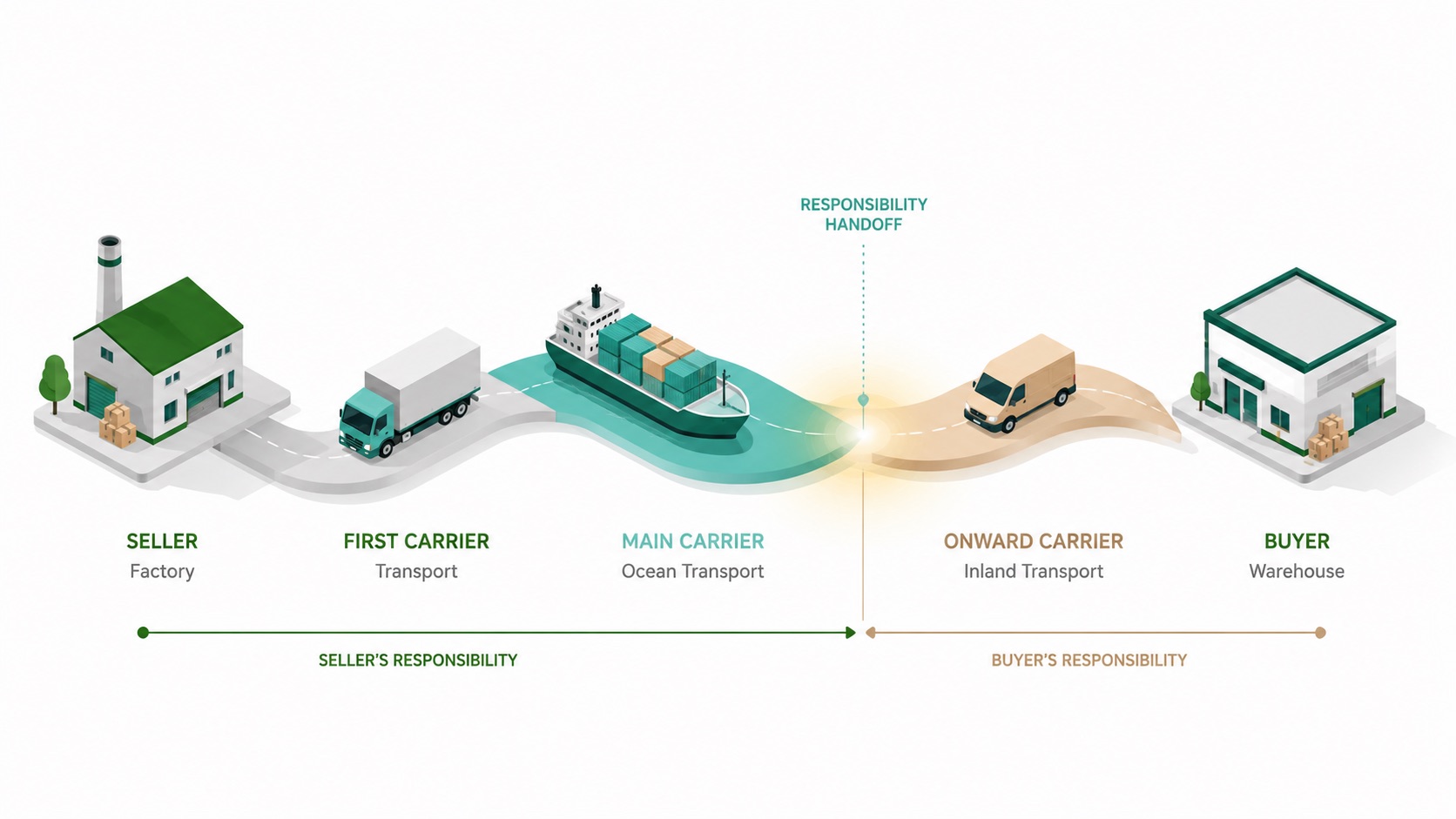
Two companies agree a price, sign a contract, and then argue for a month about who was supposed to pay for the ocean freight. It happens constantly, and it happens because nobody pinned down the Incoterm. Those three-letter codes — EXW, FOB, CIF, DDP — are not shipping jargon you can skip. They decide who arranges transport, who pays for each leg, and, most importantly, the exact point where the risk of loss or damage jumps from the seller to you.
Incoterms are published by the International Chamber of Commerce. The current set, Incoterms 2020, has 11 rules. Seven work for any mode of transport; four are only for sea and inland waterway. Below is the whole picture, then each rule in plain terms.
The one table that matters
Read this left to right for any rule: how far does the seller's responsibility reach, and where does yours begin?
| Rule | Mode | Seller delivers / risk passes at | Who pays main freight |
|---|---|---|---|
| EXW | Any | Seller's premises | Buyer |
| FCA | Any | Named place / carrier | Buyer |
| FAS | Sea | Alongside the ship | Buyer |
| FOB | Sea | On board the ship | Buyer |
| CFR | Sea | On board (risk) / destination port (cost) | Seller |
| CIF | Sea | On board (risk) / destination port (cost) | Seller + insurance |
| CPT | Any | First carrier (risk) / destination (cost) | Seller |
| CIP | Any | First carrier (risk) / destination (cost) | Seller + insurance |
| DAP | Any | Destination, ready to unload | Seller |
| DPU | Any | Destination, unloaded | Seller |
| DDP | Any | Destination, duties paid | Seller (everything) |
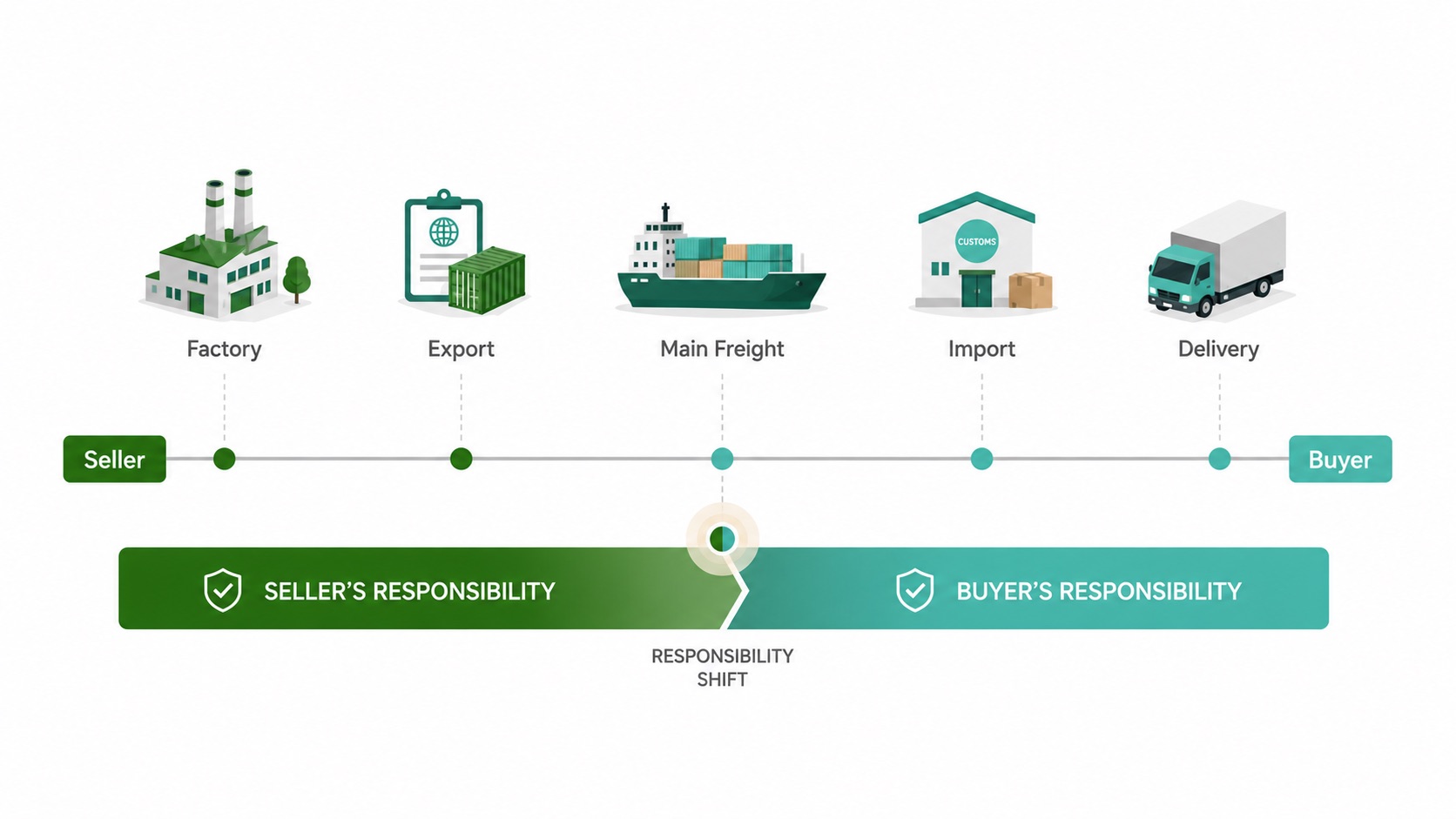
Group E — the seller does the least
EXW (Ex Works). The seller makes the goods available at their factory or warehouse and stops there. You handle loading, export clearance, freight, insurance, and everything after. It looks cheap on the invoice, but you inherit the hardest part — getting the goods out of the seller's country. First-time importers usually regret picking EXW.
Group F — you pay the main freight
FCA (Free Carrier). The seller clears the goods for export and hands them to a carrier you nominate, at an agreed place. The most flexible rule and the modern replacement for FOB when you ship containers or use air.
FAS (Free Alongside Ship). The seller delivers next to the vessel at the port. Used mainly for bulk cargo like grain or machinery.
FOB (Free On Board). Risk passes once the goods are on board the vessel. Hugely popular and often misused — FOB is only correct for sea freight and loose or break-bulk cargo. For containers, FCA is the right call.
Group C — the seller pays freight but not the risk to the end
This is the group that trips people up. The seller books and pays the main carriage, but the risk still passes to you early — at the origin, not the destination. So the seller pays to move a box that is already, legally, at your risk.
CFR (Cost and Freight) and CIF (Cost, Insurance and Freight) are the sea-only pair. CIF adds insurance — but only the minimum cover, so read the policy. CPT (Carriage Paid To) and CIP (Carriage and Insurance Paid To) are the any-mode equivalents; CIP now requires the seller to buy higher, all-risks insurance.
Group D — delivered to your door
DAP (Delivered At Place). The seller brings the goods to the agreed destination, ready to unload. You handle import clearance and duty.
DPU (Delivered at Place Unloaded). Same as DAP, but the seller also unloads. The only rule that puts unloading on the seller.
DDP (Delivered Duty Paid). The seller does absolutely everything, including paying import duty and taxes in your country. Convenient, but you pay for that convenience in the price — and a seller unfamiliar with your customs system can create expensive messes.
What changed in the 2020 revision
If you're working from an older contract template, a few things moved when Incoterms 2010 became 2020:
- DAT became DPU. The old "Delivered at Terminal" was renamed "Delivered at Place Unloaded" and widened to cover any destination, not just a terminal.
- CIP now needs better insurance. Under CIP the seller must buy all-risks cover (Institute Cargo Clauses A). CIF still only requires the minimum, so under CIF the buyer often tops up the policy themselves.
- FCA got a bill-of-lading option. Buyer and seller can now agree that the carrier issues an on-board bill of lading to the seller — useful when a letter of credit demands one.
- Security and cost allocation are spelled out more clearly, so there's less room to argue over who pays terminal handling.
One thing that did not change: insurance is only ever the seller's job under two rules — CIF and CIP. Under every other term, if you want the goods covered in transit, you arrange it. Assuming "someone must have insured this" is how uninsured containers end up at the bottom of the sea with nobody paying out.
How to choose
There is no "best" Incoterm, only the right one for how much control and risk you want. A quick rule of thumb:
- New to importing and want it simple? DAP or DDP — the seller carries most of the load.
- Want control over freight and better rates? FCA for containers, FOB for loose sea cargo.
- Never agree a C-rule assuming the seller carries the risk to destination. They don't — that's the classic, costly misunderstanding.
Whatever you pick, always write it as the rule plus a named place and the year — for example, "FCA Shanghai, Incoterms 2020." Vague terms are where disputes are born.