
Ask an importer what their goods cost and most will quote the supplier's price. That number is almost always wrong. By the time a shipment reaches your warehouse, it has picked up freight, insurance, customs duty, import tax, and a handful of fees. Add them up and that is your landed cost — the only figure that tells you whether a product is worth selling.
The good news: the calculation follows a fixed order. Once you've done it by hand a couple of times, it stops being intimidating.
The formula
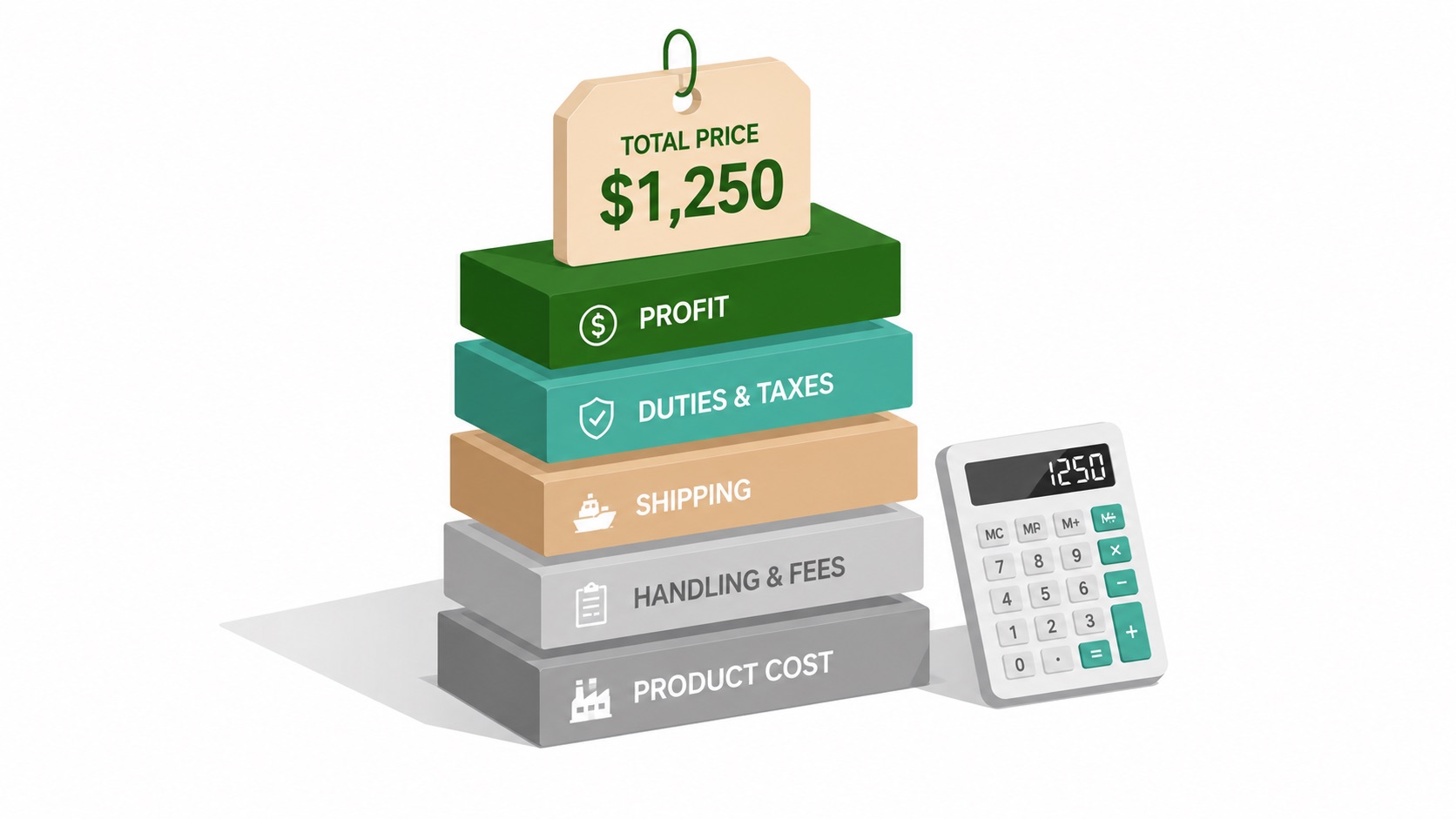
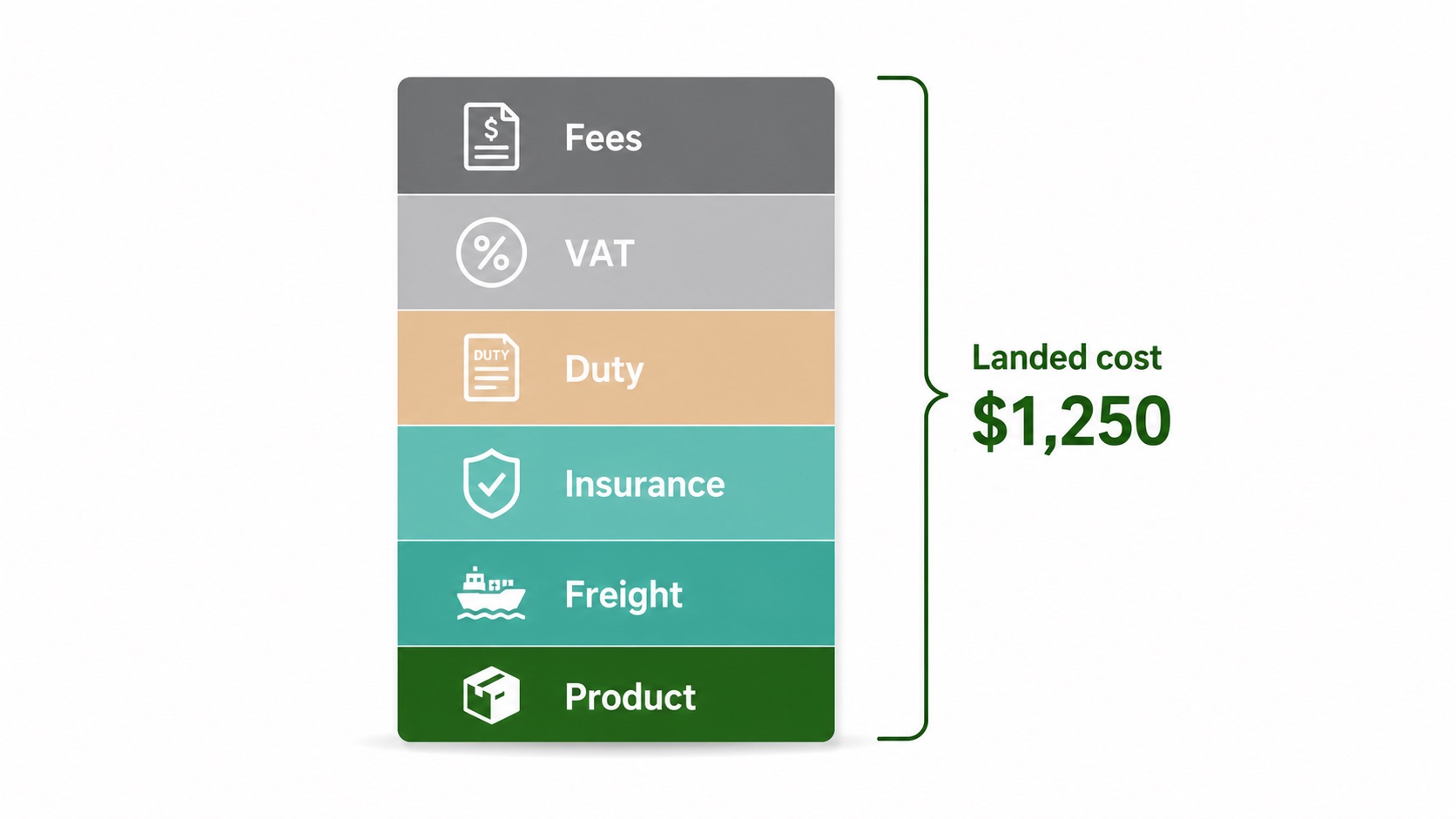
Landed cost is a stack, and each layer builds on the one below it:
Landed cost = Product cost + Freight + Insurance + Customs duty + Import VAT/tax + Broker & handling fees
The two layers people get wrong are duty and VAT, because they aren't percentages of the product price — they're percentages of a customs value that includes shipping. Miss that and your estimate is short every time.
Step one: the customs value
Duty is charged on the customs value, not the invoice price. Most countries use the CIF value — Cost, Insurance and Freight — meaning the goods plus the cost of getting them to the border. A few, like the US, assess duty on the FOB value (goods only). Check which basis your country uses before you calculate; it changes everything downstream.
Step two: the duty
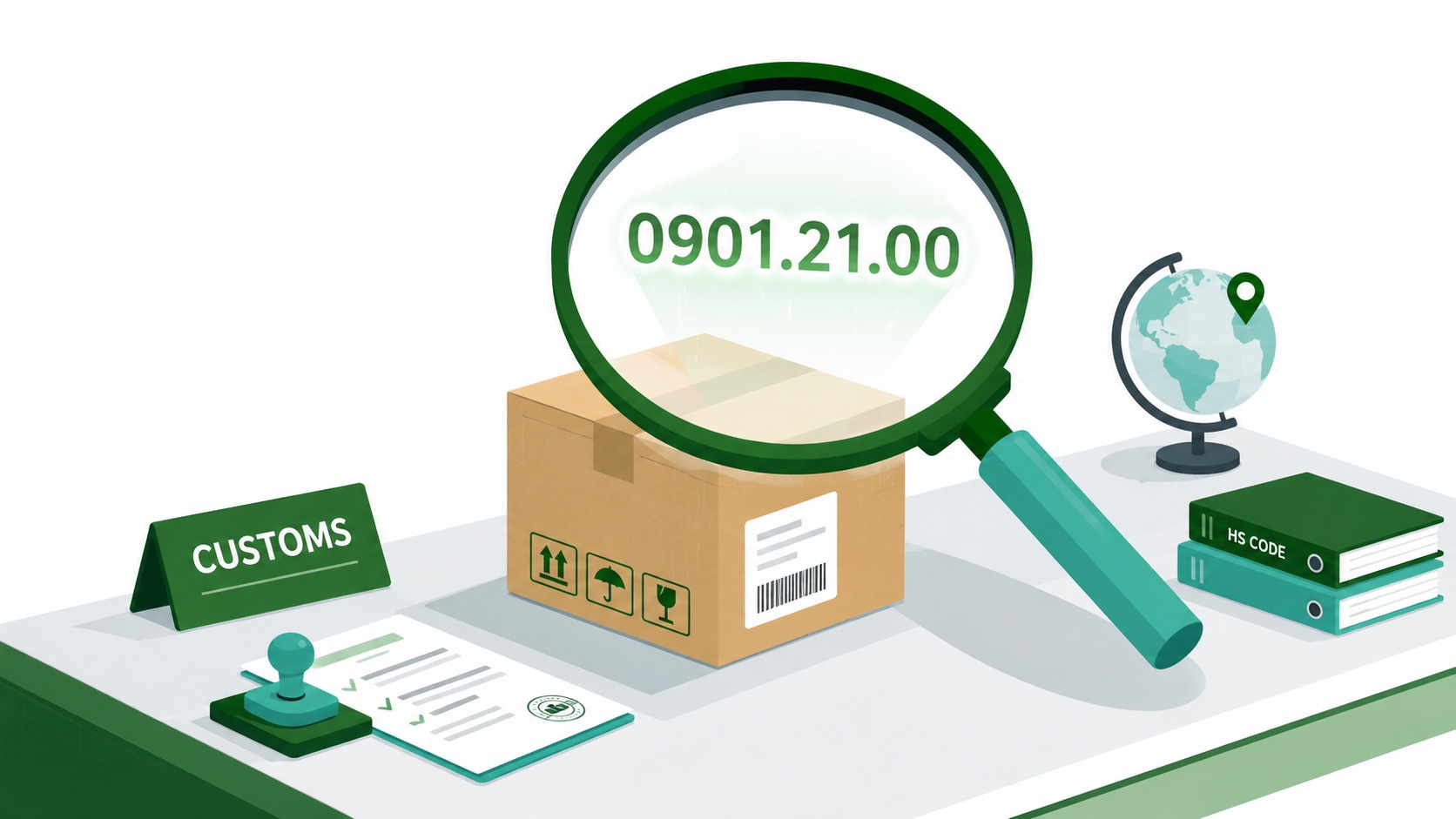
Duty = customs value × the duty rate for your product's HS code. The rate comes from your country's tariff schedule and depends entirely on correct classification. A one-line difference in the HS code can swing the rate from zero to double digits.
Step three: import VAT or sales tax
Most countries then charge VAT — and here's the catch that surprises people: VAT is calculated on the customs value plus the duty. You pay tax on the duty. So the order of operations matters: duty first, then VAT on the new, larger base.
A full worked example
Say you're importing 500 phone cases at $8 each into a country that uses CIF value and charges 20% VAT, with a 6% duty rate on your HS code.
| Line | Calculation | Amount |
|---|---|---|
| Product cost | 500 × $8 | $4,000.00 |
| Freight | — | $600.00 |
| Insurance | — | $50.00 |
| Customs value (CIF) | 4,000 + 600 + 50 | $4,650.00 |
| Customs duty | 4,650 × 6% | $279.00 |
| Import VAT | (4,650 + 279) × 20% | $985.80 |
| Broker & handling | — | $90.00 |
| Total landed cost | — | $6,004.80 |
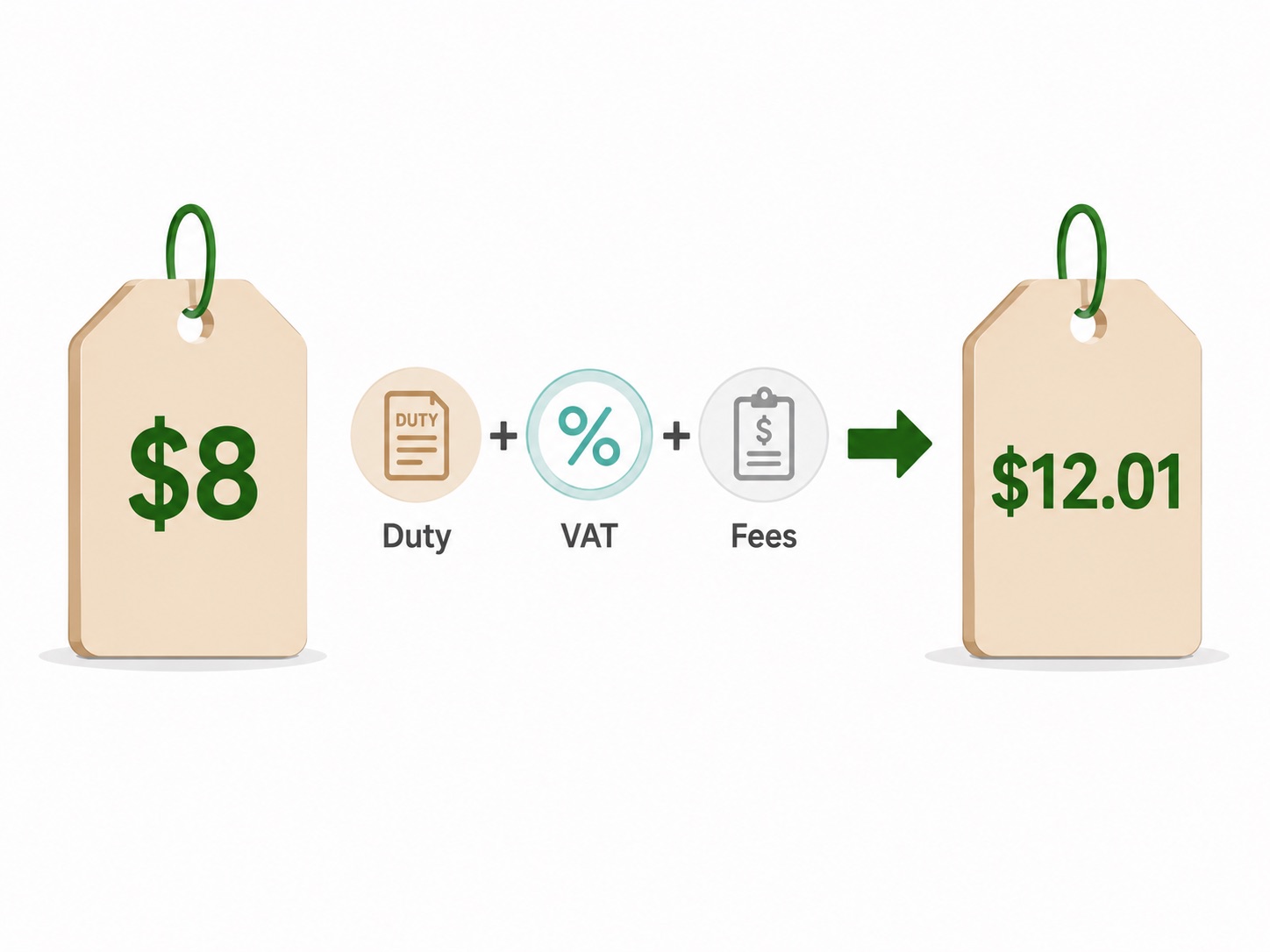
Per unit, that $8 case actually costs $12.01 landed — 50% more than the invoice price. Price your product off $8 and you'd be selling at a loss without knowing it.
Where the money goes
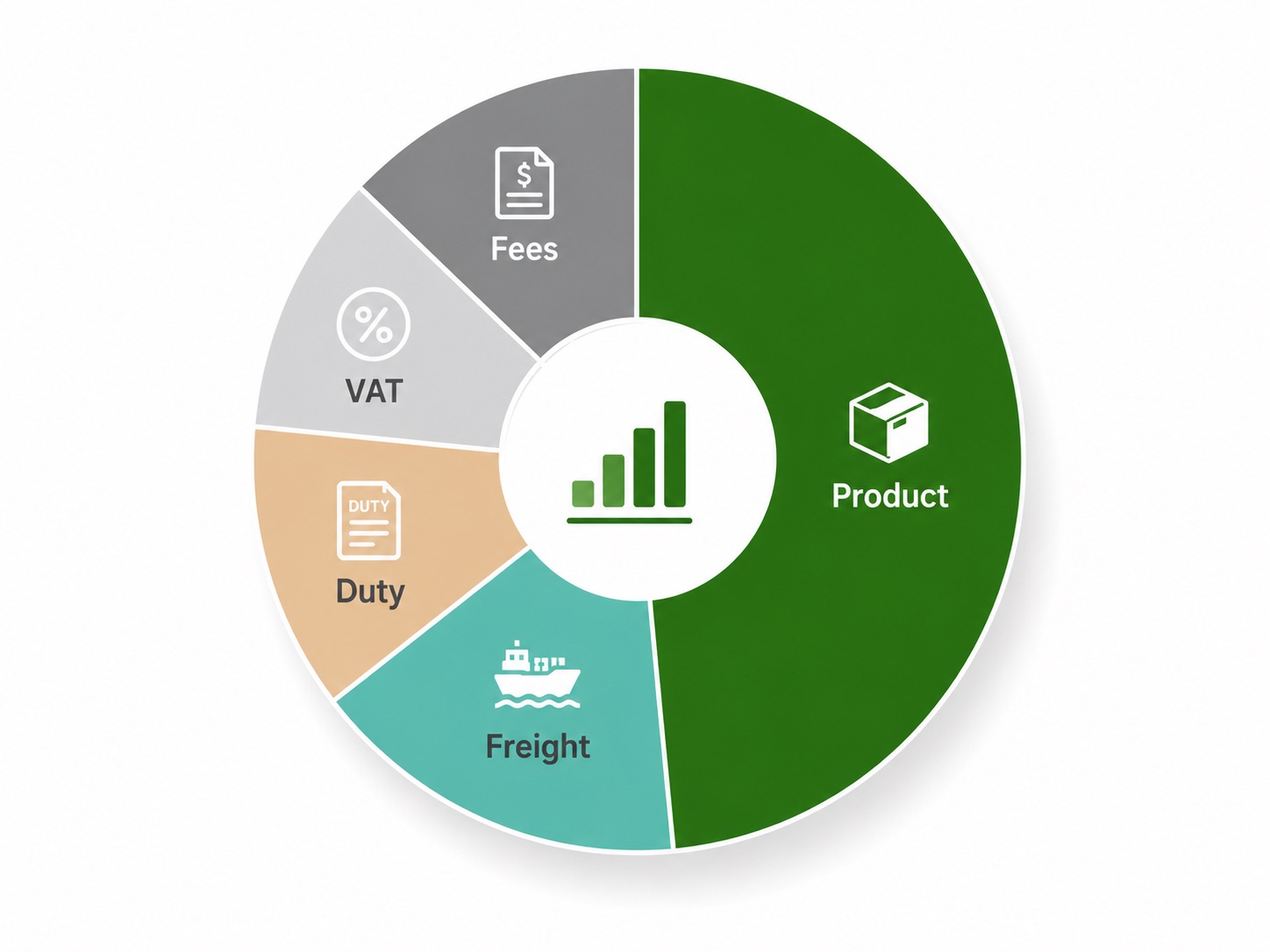
It helps to see the shape of a landed cost. In the example above, the product is about two-thirds of the total; freight, duty, VAT, and fees make up the rest. On low-margin goods, that "rest" is the difference between a healthy business and a break-even one.
Ad valorem vs specific duties
Most duty you'll meet is ad valorem — a percentage of the customs value, like the 6% above. But some goods are charged a specific duty: a fixed amount per unit, per litre, or per kilogram, regardless of price. Alcohol, tobacco, and some agricultural products often work this way, and a few carry a compound duty that combines both. If your tariff line shows something like "€0.20 per kg," that's a specific duty — it won't shrink just because you negotiated a lower price.
Other charges that show up at the border
Duty and VAT are the big two, but they're not always the whole bill. Depending on the product and country, you may also meet:
- Anti-dumping or countervailing duties — extra duties on specific goods from specific countries, sometimes very steep.
- Excise duty — on alcohol, tobacco, and fuel, on top of everything else.
- Customs processing fees — a small charge for handling the entry (the US Merchandise Processing Fee, for example).
- Terminal and port handling — charged by the port, not customs, but still part of your landed cost.
None are huge on their own. Together they're the reason a "6% duty" import can land noticeably higher than 6% over the product price.
How to pay less — legally
You can't wish duty away, but you can often reduce it:
- Claim a trade agreement. If your country has a free trade agreement with the country of origin, a valid certificate of origin can cut the duty rate to a preferential level, sometimes to zero.
- Classify precisely. A more accurate HS code sometimes carries a lower rate than the broad one you assumed.
- Get the customs value right. Don't overstate it — include only what the rules require for your valuation basis.
Quick answers
Is duty charged before or after VAT? Duty first. VAT is then calculated on the customs value plus the duty.
Does freight really get taxed? In CIF countries, yes — freight and insurance are part of the customs value that duty and VAT are based on.
What if I don't know my duty rate? It's tied to your HS code. Classify the product first, then look up the rate for your destination country.
Can I estimate this before ordering? You should. Run the duty and tax for your route and HS code up front — the taxprice.org calculator does this in one pass so you see the landed number before you commit to a purchase order.